

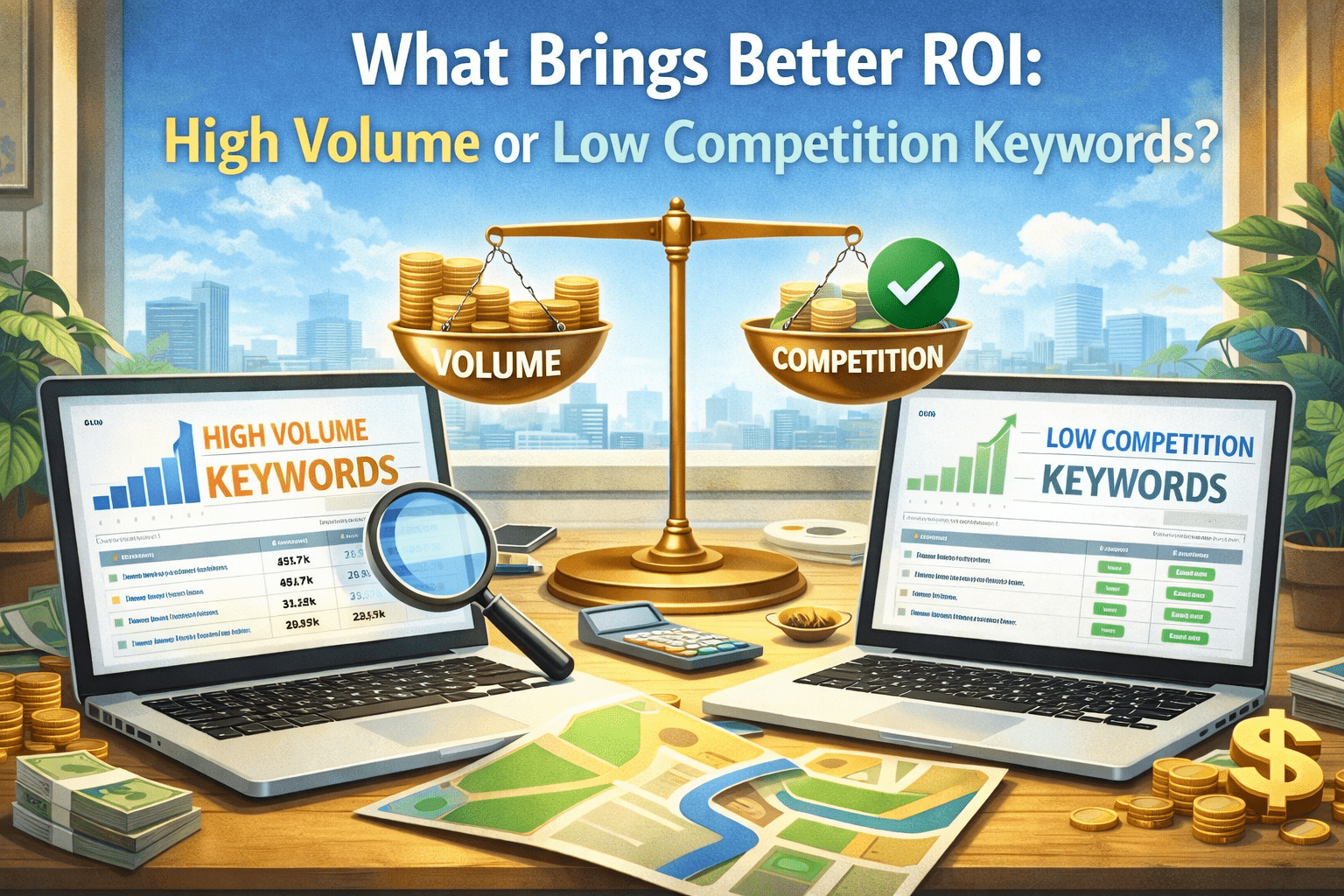
Keyword research is among the very first skills that anyone can learn in the field of search engine optimization. Then, almost immediately the same problem arises. Should we focus on terms that have huge search volumes that could result in thousands of users? It is better to concentrate on phrases with low competition which have the potential to rank higher? This question has led to endless debates between the owners of websites and marketers for a number of years. However, the truth that is based on the way the search engines work in the present is that neither metric alone is the complete picture. The main driver of traffic is not volume, nor scores for competition. It’s how a website solves the issue in the question.
The Trap of Chasing Big Numbers
Keywords that are high volume are definitely appealing. A keyword that has more than 50,000 or 10,000 monthly visits attracts you in a way that is irresistible. The logic is obvious. If even a small portion of these searchers end up on the website then the number of visitors will be quite impressive. But there’s a caveat that is often overlooked by people.
Google Keyword Planner and similar tools provide estimates of search volume however, that is not a representation of a single unifying public. Keywords such as “bark” may refer to the outer layer a tree, or to the sound made by dogs. In the vast majority of searchers, some are trying to determine the type of tree they are looking for while others are looking to determine whether their dog is sick A smaller portion might be looking for dog training strategies. The volume of searches is divided between completely different purposes and only a small portion of the searchers are relevant to one company.
Intentionally chasing volume without understanding results in pages that draw visitors but do not give the visitor what he requires. This results in an increase in bounces, low levels of engagement and little results or conversions.
Why Competition Scores Are Not What They Seem
On the other hand of the argument Keywords with low competition often are praised for being the most effective decision to make. According to the theory, the more websites that are targeting the same phrase, it will be more easy to be found. While there’s some truth in this, it is crucial to realize how competition score are generated through SEO software, and not search engines. Google doesn’t use the metric of competition to decide which websites to be ranked. It’s focus is on providing the most accurate information in the simplest format and fastest manner that is possible.
It is essential for a website to be visible on every search result and there’s no reason why it shouldn’t be a well-designed site with useful information. Pages that are able to answer questions clearly and provide facts in a concise credible manner are able to rank for terms that are categorized by tools as extremely competitive. This is more often than we think, and especially during updates to the core algorithm in which Google examines which pages merit top rankings.
The Smarter Approach: Optimise for Topics, Not Individual Phrases
Instead of focusing solely on one keyword’s popularity or its competition rating an effective method is to think about the subject matter. Topics encompass a variety of related search terms, and through the creation of pages that cover the entire range of information that a person might require to know, one site could rank for dozens, and even hundreds keywords.
Use a phrase such as “micro needling” for an example. The motive of this search might be educational, in which case one wants to know more about the process. It could also be a comparative search or comparative, where they would like to understand how it stacks against other options. Also, it could be transactional, meaning they’re ready to make an appointment. A website that has dedicated content for every stage of the journey, such as galleries of before-and-after photos, comprehensive guides, pages for comparison, and a straightforward booking page, helps build the credibility that search engines recognize.
Knowing what are the 9 types of keywords in SEO keywords aids during this procedure. Understanding the distinction between long-tail, short-tail transient, branded, and non-branded and informational, as well as navigational geo-targeted, commercial and other keywords helps content creators map the best strategy to cover all angles of a subject rather than relying solely on a single word.
Long-Tail Phrases Are the Hidden Goldmine
If tools for researching keywords filter results to display only keywords with at least 500 monthly searches, a large amount of data that is valuable gets lost. Long-tail keywords, the more specific, low volume queries that actual users enter into search engines each day, often are the missing element that links the topic together.
These more complex phrases usually answer genuine consumer inquiries. “What is the most comfortable running shoe for flat feet” has a lower volume in comparison to “running footwear,” but the person writing it is much closer to making a purchasing decision. A response to these specific questions within an overall topical page improves the overall relevancy of the information and allows it to rank in the top search terms, too.
The benefit of this method is that it eliminates the usual issue of content cannibalisation. This is when many pages on a single website compete in the same category. When each page is tied to a specific topic or intention, there’s no confusion among search engines regarding the page that should be ranked for what query.
Authority and Trust Still Play a Crucial Role
The creation of great content is crucial but it’s just one aspect of. In the case of competitive topics, in which established brands dominate the results on search engines A smaller or newer website must be able to demonstrate external signs of trust and authority in order to make it through. This is the point where the guest-posting services can be extremely useful. Writing high-quality content on trusted websites will earn backlinks which indicate trustworthiness for search engine. In time, these backlinks can help a site build the level of authority required to compete with larger and more competitive terms.
There is a interaction that occurs. When a page is well-crafted and begins to rank and attracts visitors and gaining backlinks from other websites that are deemed to be useful by the content. This improves the position of the site and strengthens it against rivals who want to drag it down.
Create the Content Now, Even if Rankings Come Later
One of the biggest errors webmasters make is not to write content due to the fact that the keyword is too competitive at the moment. The problem with that reasoning is quite simple. If the content isn’t exist, it won’t be able to rank when an opportunity arises. The core algorithm changes often shake up results of searches, and pages which were sat in a quiet spot on the third or fourth page could suddenly rise to the top of the page if Google determines that they provide the most relevant answer to a question.
Being able to have comprehensive, well-structured and useful content ensures that the site is in a position of benefiting from these changes. The process of waiting until the website is “strong enough” is often a way to miss chances that may not be available again.
Stop Counting and Start Solving
The debate over high volume and low-competition keywords misses the mark. In 2026, search engines will be powered by machines learning as well as AI systems that know what content can solve, not only the keywords it has. Pages that display genuine expertise that answer questions from real people and assist users in making an informed decision will be able to draw attention regardless of what a keyword tool’s report on the volume of traffic or the difficulty score.
The creators and businesses that concentrate on being the best source for their customers and assist in this efforts with effective strategies like topicsal maps as well as Guest Posting services are those that create long-term, organic traffic that grows over the course of time. The numbers on the tool’s keyword are just a starting point, not a final destination. The real traffic is generated by genuine solutions.

